ACPC Offline Admission Process Click here
Examination Result Click here to know more

ACPC Offline Admission Process Click here
Examination Result Click here to know more







Awareness Session on Key Sections of the Information Technology Act, 2000, with Quiz

Participants |
50 |
Contact No. |
|
Start Date |
07/10/2026 11:00 AM |
End Date |
07/10/2026 12:00 PM |
Venue |
Acharya Motibhai Patel Institute of Computer Studies |
Social Media Share |
Description
|
Event title |
Awareness Session on Key Sections of the Information Technology Act, 2000, with Quiz |
|
Organised by |
A M Patel Institute of Computer Studies, Ganpat University |
|
Presenters |
Batch : 2025 MCA Sem-3 Students (P13A5DFC DIGITAL FORENSICS AND CYBER SECURITY TOOLS) |
|
Target audience |
MCA Sem-1 students |
|
Number of participants |
50 |
|
Date |
07 October 2026 |
|
Time |
11:00 AM To 12 : 30 PM |
|
Venue |
Lab-13 , AMPICS |
|
Faculty coordinator |
Ms.Vishnuba H. Chavda |
1. Introduction
The Information Technology Act, 2000 is the main law in India governing electronic records, digital signatures and cyber crime. As the Act was amended in 2008, it also covers offences such as identity theft, privacy violation and cyber terrorism. Knowledge of these provisions is essential for MCA students who will work with software systems, data and networks.
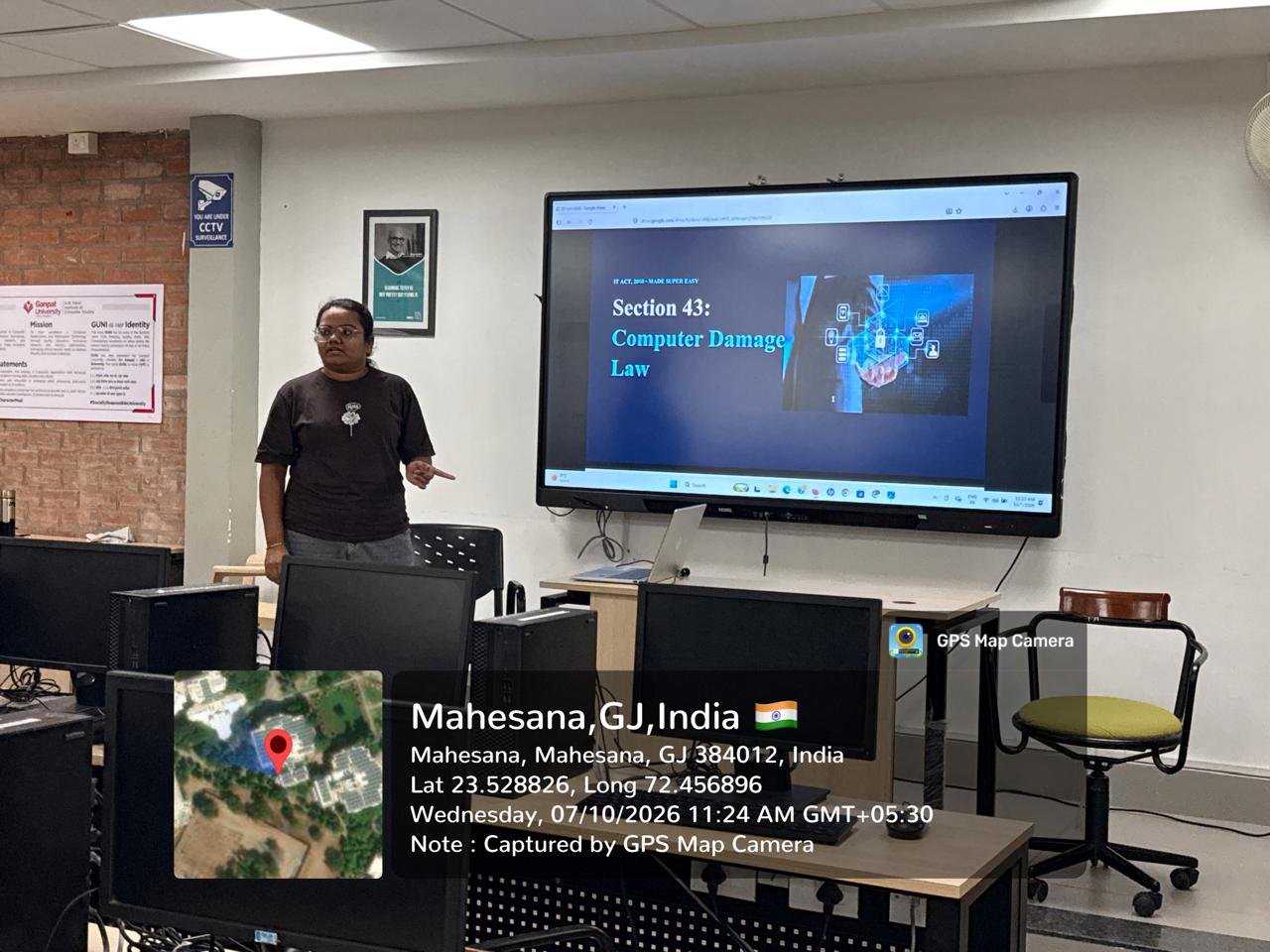
The MCA Department organised a student-led presentation on the key sections of the Act on 07 October 2026. MCA Sem-3 (P13A5DFC DIGITAL FORENSICS AND CYBER SECURITY TOOLS) students presented to MCA Sem-1 students, and the session ended with a quiz.
2. Objectives
- To introduce MCA Sem-1 students to the main provisions of the IT Act, 2000.
- To build presentation and communication skills of Sem-3 students by letting them teach their juniors.
- To promote awareness of cyber law, cyber ethics and safe digital practices.
- To check understanding of the topic through an interactive quiz.
3. Event description
The session began with a welcome and a short introduction to the Act. The presenters then explained the key sections using a visual poster and slides, grouped into three areas:
- Cyber offences: Sections 65 (tampering with computer source documents), 66 (computer-related offences), 66B to 66F (stolen computer resource, identity theft, cheating by personation, violation of privacy, cyber terrorism), 67, 67A and 67B (obscene, sexually explicit and child sexual abuse material in electronic form).
- Penalties and compensation: Sections 43 (penalty and compensation for damage to computer systems), 46 (power to adjudicate) and 47 (factors for deciding compensation).
- Powers, duties and reach of the Act: Sections 68 (Controller's power to give directions), 69 (interception, monitoring and decryption), 70 (protected systems), 72 (breach of confidentiality and privacy), 73 (false Electronic Signature Certificate), 75 (extraterritorial application), 80 (police powers to enter and search) and 85 (offences by companies).
At the end of the presentation, a quiz was conducted for the Sem-1 students to test what they had learned.
4. Learning outcomes
- Participants can name the major sections of the IT Act, 2000 and explain what each one covers.
- Participants can tell the difference between civil liability (compensation) and criminal offences under the Act.
- Participants understand the legal risks of hacking, identity theft, privacy violation and publishing unlawful content.
- Presenters gained confidence in researching, structuring and delivering a technical topic.
5. Glimpse of the Events
|
|
|
|
|
|
|
|
|


6. Conclusion
The session was a useful learning experience for both the presenters and the audience. It increased awareness of cyber law among MCA students and encouraged peer learning. The department plans to hold similar sessions on other topics of cyber security and law.
Gallery
A workshop on the topic ‘Cyber Security: Privacy & Data Protection&...