ACPC Offline Admission Process Click here
Examination Result Click here to know more

ACPC Offline Admission Process Click here
Examination Result Click here to know more






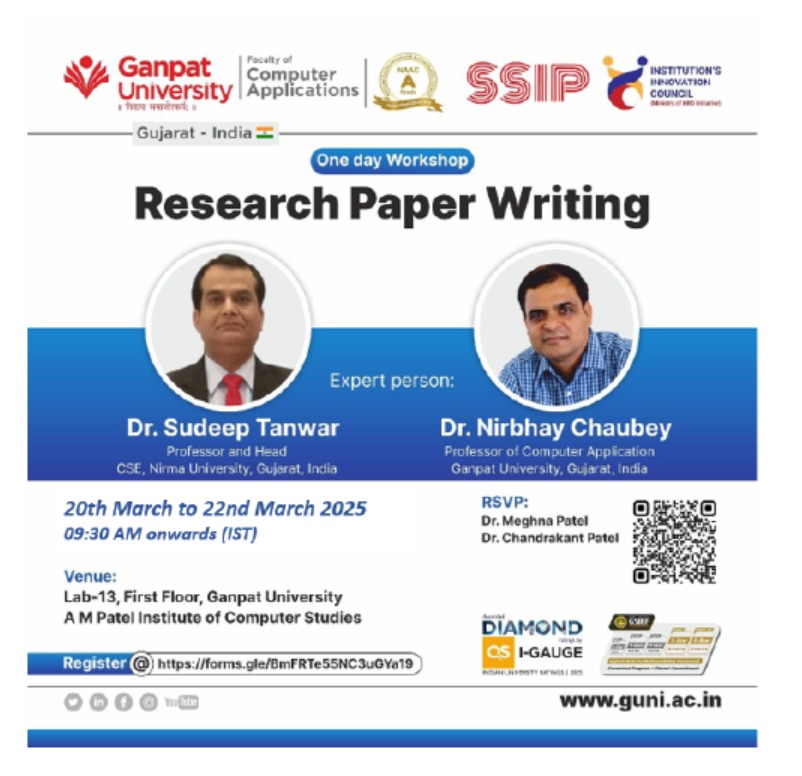
Report of Three-Days Workshop on Research Paper Writing
Organizers |
Faculty of Computer Applications |
Participants |
45 |
Contact No. |
|
Start Date |
20/03/2025 09:30 AM |
End Date |
22/03/2025 03:30 PM |
Venue |
Acharya Motibhai Patel Institute of Computer Studies |
Social Media Share |
Description
The School of Computer Applications at Ganpat University has organized a workshop over three consecutive days concerning "Research Paper Writing". This workshop's purpose is to aid faculty and research students in becoming better qualified in their research skills, writing skills, and understanding of methodologies; thus increasing their ability to publish high-quality research papers as well as providing them with additional resources available through the use of digital tools.
Dr. Nirbhay Chaubey, Professor and Dean of the School of Computer Applications, welcomed the resource person, Dr. Sudeep Tanwar, a professor at Nirma University (Ahmedabad, India), and explained the primary goal of this intensive three-day workshop.
Resource Person:
Name; Dr. Sudeep Tanwar.
Position; Professor; Computer Science and Engineering Nirma University - Ahmedabad (Gujarat State - India)
Day 1 Supplies Participants a Foundation for Writing a Scientific Research Paper
Participants learned about the critical components of the scientific writing process. Although most of these items are obvious to researchers, Dr. Tanwar spent a lot of time providing guidance in this area. Dr. Tanwar emphasized the need for clear writing that communicates original ideas on a gap in current research through a specific form of scientific writing.
Content Presented at Day 1's Session
1. Introduction to Scientific Research Writing.
● Purpose of Academic Research Papers.
● Types of Academic Research Papers.
● Fundamentals of Academic Writing. 2. Definition of IMRaD Paper Structure.
● How to Write a Title.
● How to Write an Abstract.
● How to Write the Introduction/Problem Statement.
● How to Use the Research Gap Found in PhD Research.
3. Finding the Research Gap and Refining it.
● How to Review Already Published Literature.
● What to Include and What to Exclude When Finding the Gap in a Literature Review.
● Identifying Research Opportunities and Open Issues.
4. How to Conduct a Literature Review.
● Types of Literature Reviews.
● Where to Find Helpful Databases and Scholarly Tools.
● Common Error to Avoid When Conducting a Review.
5. Interactive Activity: Participants will review a sample of research papers written by their peers and then engage in a group discussion on strengths and weaknesses identified in those papers.
DAY 2: Research Methods, Ethics and Digital Tools
Theme: Developing the Research Design and Practicing Ethical Writing
Day 2 was focused on the importance of using the correct research methods, ethical considerations and displaying current digital tools used in the field of research.
Sessions Presented:
1. Introduction to Research
● Qualitative Research Vs Quantitative Research
● Mixed Methods Research
● Data Collection and Sampling
2. Choosing Research Methodology
● Writing Methodology and Results Sections
● Data Presentation
● Tables, Graphs and Diagrams
● Results and Observations
3. The Ethics of Research and Plagiarism
● Researcher's Ethical Responsibility
● How to Properly Paraphrase
● University Policies on Plagiarism
● Plagiarism Detection Tools
4. Digital Tools for Research Assistance
● Mendeley, Zotero, EndNote
● Google Scholar, Scopus, Web of Science
● Artificial Intelligence Tools for Organizing Research
● Reference Managers and Citation Tools
5. Hands-On Practice
● Participants Developed Reference Libraries
● Drafted Methodology Sections
DAY–3: Advanced Writing, Publication Strategies & Practical Assignments
Day 3 primarily consisted of a series of presentations, discussions, and activities to provide you with the necessary tools for completing your draft. In addition to the training sessions outlined above, additional sessions included:
1. Advanced Writing Skills for Research
● Coherence and Flow Improvement
● Strong Arguments Development
● Discussion and Conclusion Section Development
2. Do's and Don'ts of Research Writing
● Common Mistakes in Research Writing
● How Reviewers Evaluate Papers
● Structuring Content for Acceptance
3. Journal Selection and Publication Process
● Indexing and Impact Factors
● Categories of Journals (Scopus, SCI, ESCI)
● Open versus Subscription-based Journals
● Submission Process and Responses to Reviewer Comments
4. Research Trends Across Emerging Technologies
● IoT, Cyber Security
● Wireless Networks
● AI & Machine Learning
● Data Science research directions
5. Hands-on Group Work
● Twenty-six (20) research groups provided a draft outline for a research paper.
● Each group presented their draft for review and received constructive feedback/suggestions for refinement from an expert.
Gallery
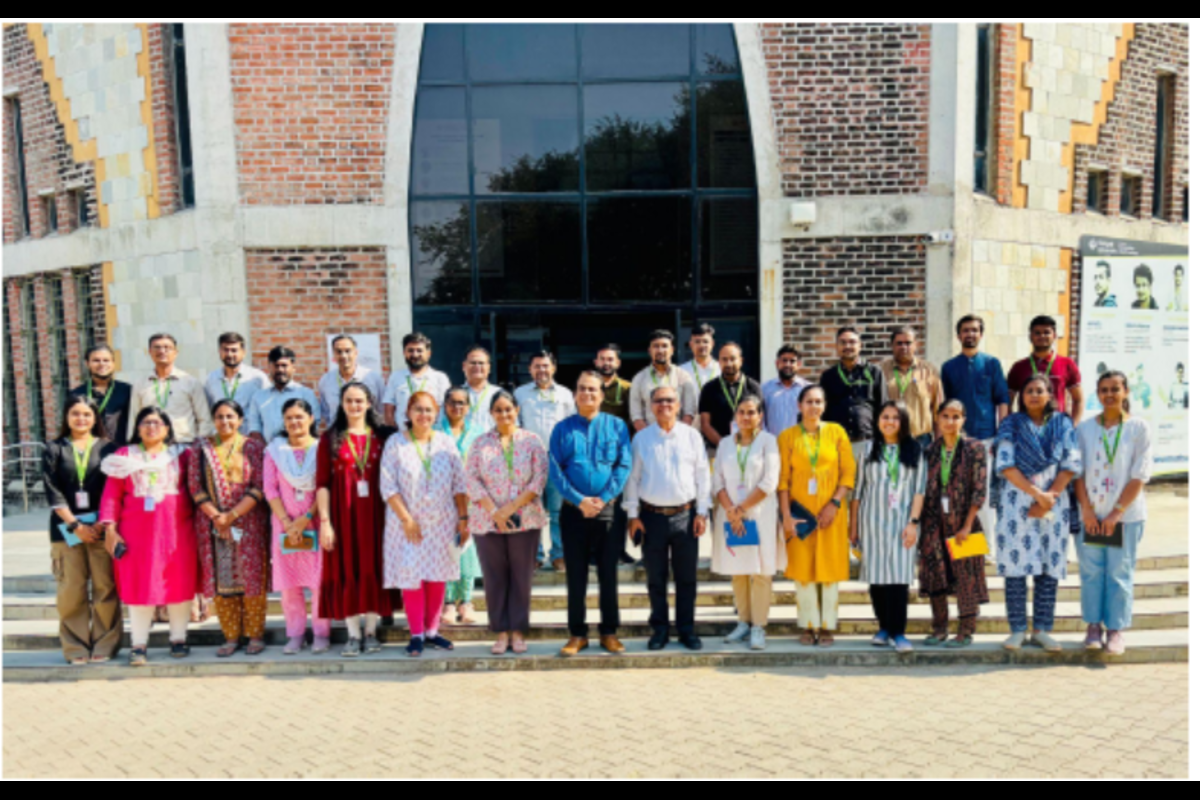
A workshop on the topic ‘Cyber Security: Privacy & Data Protection&...